Sea-Doo Speedster 200: The 6-Meter Twin-Engine Jet Boat That Drives Like a Jet Ski on Steroids
The Sea-Doo Speedster 200 proves you don’t need a massive boat to have massive fun. This agile 6.02-meter twin-engine jet boat combines lightning-fast acceleration, sharp handling, and family-friendly space in one compact package. With up to 510 horsepower on tap and no propeller to worry about, it delivers pure watersport thrills while letting you play safely in shallow water.
Sea-Doo Speedster 200: The 6-Meter Twin-Engine Jet Boat That Drives Like a Jet Ski on Steroids
The Sea-Doo Speedster 200 proves you don’t need a massive boat to have massive fun. This agile 6,02-meter twin-engine jet boat combines lightning-fast acceleration, sharp handling, and family-friendly space in one compact package. With up to 510 horsepower on tap and no propeller to worry about, it delivers pure watersport thrills while letting you play safely in shallow water. If you’re after a boat that feels more like a high-performance toy than a traditional cruiser, the Speedster 200 might just be the most entertaining ride on the dam.
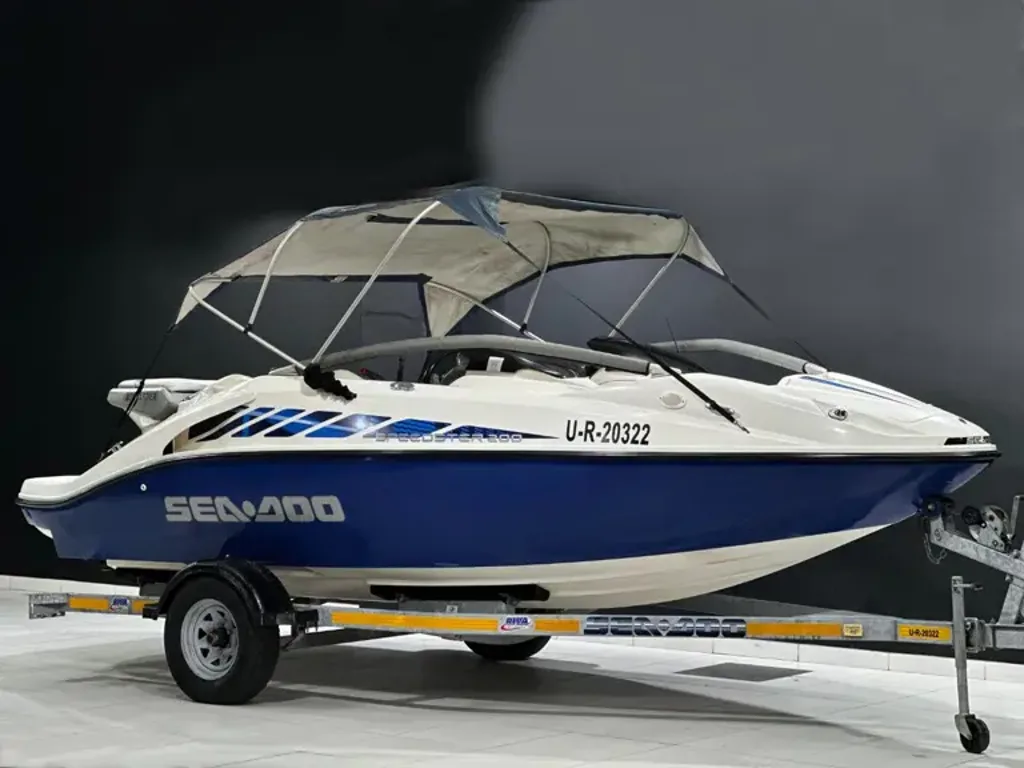
If you look at the profile shot above, you see the low-slung hull, the sharp entry at the bow, and the way the deck flows back to a wide swim platform. The blue accents on the white fibreglass give it that classic Sea-Doo energy, while the overall shape keeps the centre of gravity low for better stability at speed. This isn’t some bloated cruiser; it’s built to move.
How the Speedster 200 Came to Be
Sea-Doo made its name with jet skis in the 1980s and 1990s, but by the early 2000s the company wanted to expand into bigger boats that still felt like their personal watercraft roots. The Speedster line, including the 200 model, was their answer. They took the proven Rotax 4-TEC four-stroke engine technology — already reliable in their PWCs — and doubled it up. Early versions offered naturally aspirated setups around 310 horsepower total, while later supercharged versions pushed 370, 430, or even 510 horsepower. The goal was simple: give weekend warriors a boat that could pull skiers, wakeboarders, and tubers all day while still hitting highway speeds on open water.
The 200 model filled a sweet spot in the lineup. It was bigger than the smaller Challenger or Sportster boats but not as large as the flagship models. At 6,02 meters long with a 2,44-meter beam, it towed easily behind a regular SUV and fit in most garages. Dry weight hovered around 1 256 kilograms without the optional tower, making it light on its feet compared to traditional V-drive or sterndrive boats of similar size.
Under the Hood: Twin Rotax Power
The heart of the Speedster 200 is the pair of 1 494 cc Rotax 4-TEC engines. Each is a three-cylinder, four-stroke unit with electronic fuel injection. Naturally aspirated versions made about 155 hp each, while the supercharged and intercooled versions cranked out 185 hp or more per side. The 2012 brochure highlighted the top-end 510 hp package: zero to 48 km/h in 2,9 seconds and a claimed top speed of 106 km/h. Real-world tests showed the 430 hp boats hitting the mid- to high 80s km/h in calm conditions, with some tuned examples pushing past 97 km/h.
Jet drive means two stainless-steel impellers — typically 159 mm in diameter — that suck water in through grates in the hull bottom and shoot it out the back through nozzles. No propeller to snag lines or injure swimmers. Reverse is built in by redirecting the jet flow, so docking is straightforward even for beginners. Fuel capacity sits at 166,5 litres, giving a realistic range of 130 to 160 kilometres depending on how hard you push it. Owners report cruising at 55–60 km/h burns fuel at a rate that still lets you spend a full day on the dam without constant refills.
Maintenance is straightforward if you stay on top of it. The engines use regular 87-octane fuel (91 recommended for supercharged models), and the closed-loop cooling system keeps salt water out of the internals. Impellers and wear rings need periodic checks, but the overall layout lets you access everything from the large hatch in the cockpit floor.
 Cockpit Instrumentation and layout
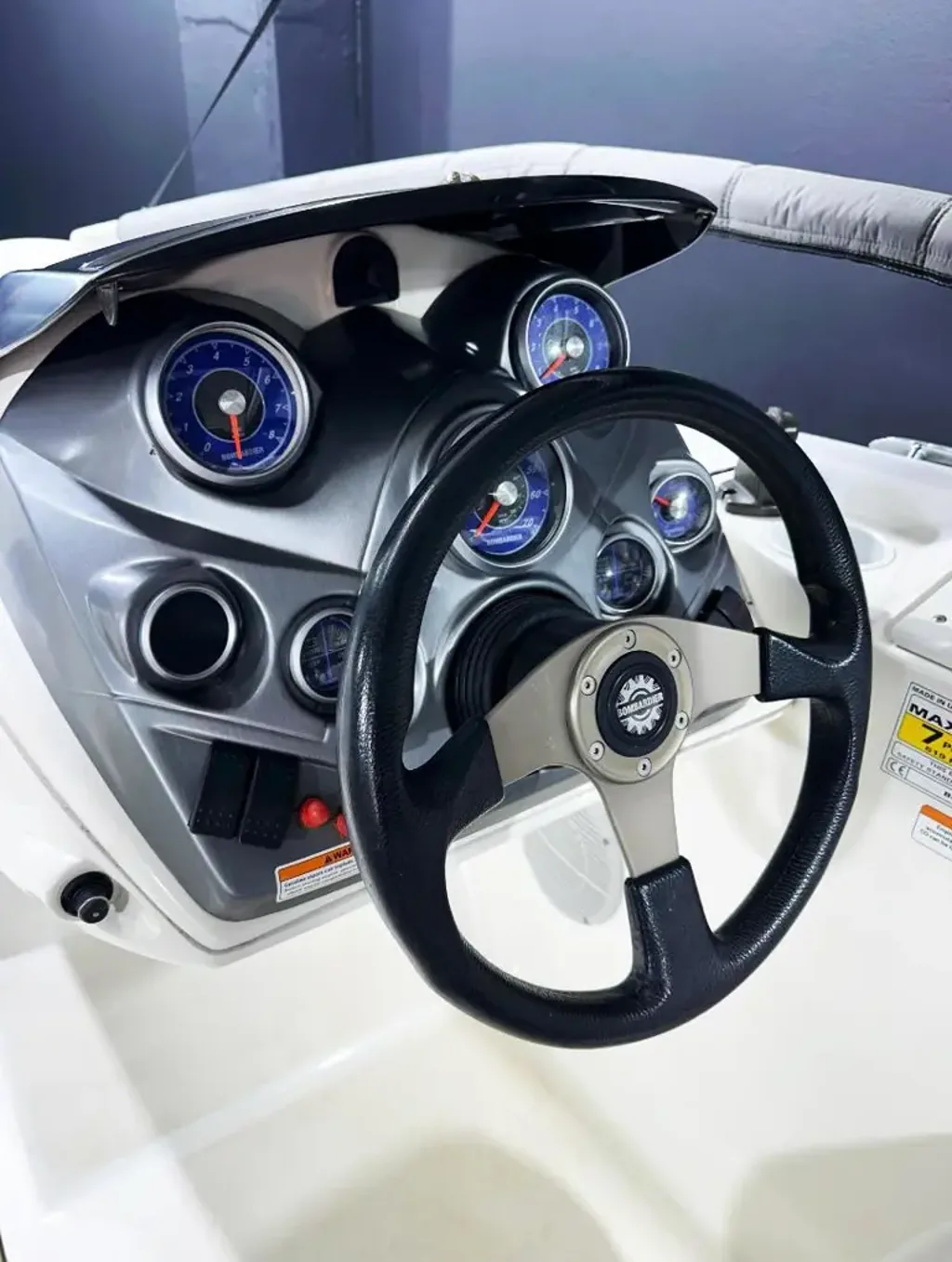
Take a look at the cockpit view in the image above. The helm sits on the starboard side with a clear instrument cluster that includes speed, RPM, fuel, and a depth finder. Dual bucket seats swivel and adjust, so the driver and passenger can face backward when anchoring up for a swim. The dash has storage cubbies, a 12-volt outlet, and room for a small stereo head unit. Everything feels purposeful — no wasted space.
Layout and Comfort on Board
Step aboard and you immediately notice how open the deck feels. The bow has a generous seating area with backrests and storage underneath. Move aft and you hit the main cockpit with L-shaped bench seating on the port side and more room across the transom. The swim platform is wide, equipped with a two-step ladder that folds away cleanly, and a pull-up ski pylon is standard on most models. Optional folding towers let you mount wakeboards or tow ropes higher for better jumps.
Storage is generous for a boat this size. There’s in-floor ski and wakeboard storage, under-seat compartments, and dual-access rear storage bins. A built-in cooler keeps drinks cold, and courtesy lights make evening runs safer. The windscreen has a pop-up deflector to cut spray, and the whole cockpit drains quickly after a wave washes over. Seven adults fit without feeling cramped, though four or five is more comfortable when everyone wants to move around.
The hull is a modified-V design with about 20–21 degrees of deadrise at the transom. It’s not a deep-V ocean runner, but it slices through small chop surprisingly well for a jet boat. In flat water it feels planted; in rougher conditions it can get lively, but the low profile keeps spray down and the ride manageable.
 Sponsored
Advertise with Motor IQ today!
Adrenaline doesn’t belong in the garage. Move your PWC fast by targeting the crowd that lives for the weekend wake.
Learn More.
Real Owners, Real Experiences
Jump on any Sea-Doo forum or Jetboaters.net thread and you’ll find a mix of passion and practicality. One owner with a 2008 310 hp model called it “a big old jet ski” that rides on rails and never leaves him stranded. Another with the 430 hp supercharged version logged 75 hours before rebuilding the superchargers but said the boat still felt fresh after years of weekend use. A common theme: these boats reward regular maintenance. Flush the engines after salt-water runs, change the oil every 50 hours, and they keep going strong.
Some owners note the ride can get choppy in bigger waves because the hull is relatively shallow to feed the jets. It sits high when stopped and can feel tippy at the jetty until you get used to it. But once moving, the stability returns. Parts availability remains good because the Rotax engines are still used in current Sea-Doo PWCs. Trailering is easy, and the boat fits in a standard garage.
Comparing It to the Competition
In its day the Speedster 200 went up against Yamaha’s AR series, MasterCraft wakesports boats, and even some Glastron or Chaparral models. The jet drive gave it an edge in shallow water and safety around swimmers. Traditional propeller boats might edge it out in pure top speed or rough-water ride, but none matched the instant acceleration or the fun factor. Fuel burn was competitive, and resale held decently because the brand carries strong recognition.
Today on the used market you can find clean examples from around R250 000 to R550 000 depending on year, hours, and options. Lower-hour supercharged boats command a premium, but the naturally aspirated versions offer lower running costs and simpler ownership.
 Sponsored
Advertise with Motor IQ today!
Stop dealing with tyre-kickers who don't know the difference between a transom and a trailer. Sell your craft to buyers ready to hit the water.
Learn More.
Why It Still Matters Today
The Speedster 200 captures a moment when Sea-Doo pushed boundaries. It proved you could have a family-friendly boat that still delivered serious adrenaline. Whether you’re carving wakes on a mountain dam, pulling tubes on a river, or blasting across a bay at sunset, the boat feels alive under your hands. The images here show the clean lines, the spacious cockpit, and the way it sits confidently at the jetty — ready for the next run.
If you’re shopping for one, check compression on both engines, listen for supercharger whine if equipped, and look for service records. A well-kept Speedster 200 will give you years of smiles per litre. It’s not the biggest boat on the water, but it might just be one of the most entertaining.

Words and Photographs by:
Maarten K
Vehicle industry veteran with 25 years of experience, bringing the latest rides, reviews, and news to MotorIQ. Read more →